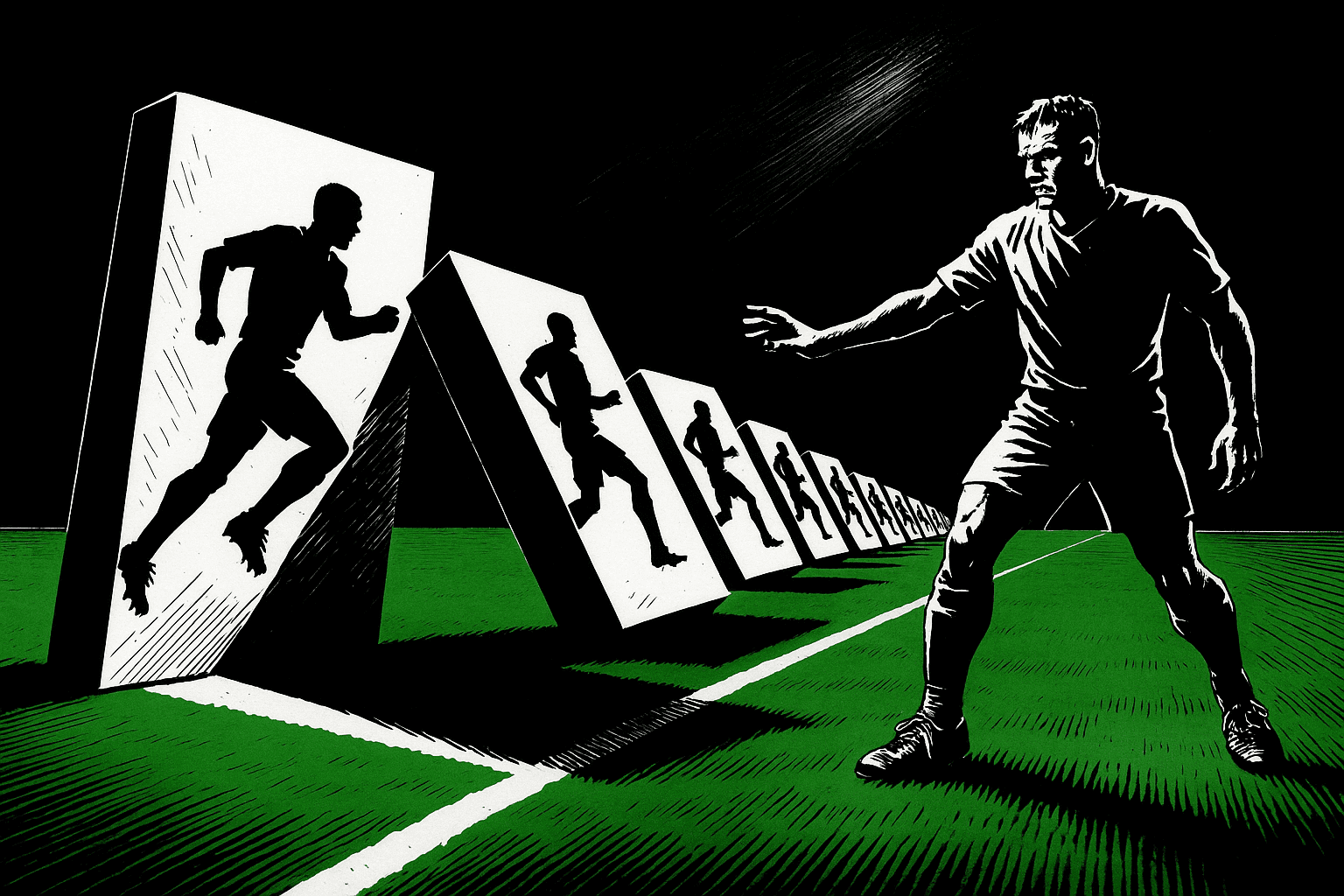

Embolo goes down, the referee blows for a foul and books... Paredes, the Argentina player who had done nothing wrong. VAR steps in for mistaken identity, one of the rules FIFA rolled out at the World Cup, and the referee corrects it. But he does not stop there: he re-referees the play, punishes Embolo's dive and, since the Swiss forward was already on a yellow, shows him the second one and sends him off in the quarter-final against Argentina. Weeks later, IFAB itself admits in writing that the protocol was never meant for this: mistaken identity only allowed correcting who gets booked, not reviewing or overturning the offence, let alone turning it into a sending-off for simulation. Translation: Embolo was wrongly sent off. Same rule, same incident, and a verdict that depended on which sentence of the rulebook you chose to read literally.
That is the football we have built. A sport that started with rules that fit on a napkin and now operates like a badly drafted penal code, with exceptions that contradict each other and officials forced to navigate a multi-branch decision tree in the 200 to 500 milliseconds they have before raising an arm. The thesis here is simple and unpleasant for those in charge. Refereeing chaos is not an accident, nor a matter of incompetent officials. It is the mathematical consequence of over-regulating a game that resists regulation.
Some legal scholars explain it with a distinction that sounds like a law textbook but is pure gold here. There are rules and there are standards. Rules are categorical and binary: if X happens, Y follows. Did the ball cross the line? Yes or no. Was the player offside at the moment of the pass? Yes or no. Standards, by contrast, require a value judgement. Was it reckless? Did the hand unnaturally enlarge the body's silhouette? Was there interference? There is no data there, only opinion.
The problem is that IFAB has spent years trying to convert standards into rules. To take subjectivity and encapsulate it in case law. And the result has been the opposite of what they sought. Instead of eliminating doubt, they have erected a maze where different guidelines clash during the same reading of a single incident. The Embolo sending-off is not an anomaly. It is the system working exactly as designed, which is to say, badly.
It is worth descending into the referee's brain, because that is where the real battle is fought. Cognitive Load Theory holds that human working memory has a strictly limited capacity. Every exception IFAB adds, every nuance about whether a touch was accidental or deliberate, whether a tackle arose from a natural biomechanical movement, adds extrinsic load. And when the sum of intrinsic and extrinsic load exceeds the capacity of the executive system, processing collapses. Full stop. The brain cannot complete a deductive logical-tree analysis in half a second. It is not designed to do that.
And on top of all that, we ask it to perform while running on empty. An elite referee covers between 10 and 12 kilometres per match, heart rate spiking and lactate accumulating in the blood. Physical stress releases massive quantities of noradrenaline, and noradrenaline shuts down precisely the prefrontal cortex, the region that governs attentional control, working memory and cognitive flexibility. We are demanding a multivariable legal ruling from someone whose brain is biochemically sabotaged by his own exertion. Add positioning to the mix. The refereeing literature notes that at distances either too long or too short error rates spike, and that there is an intermediate range at an angle close to 90 degrees where accuracy improves. It is rarely achieved.
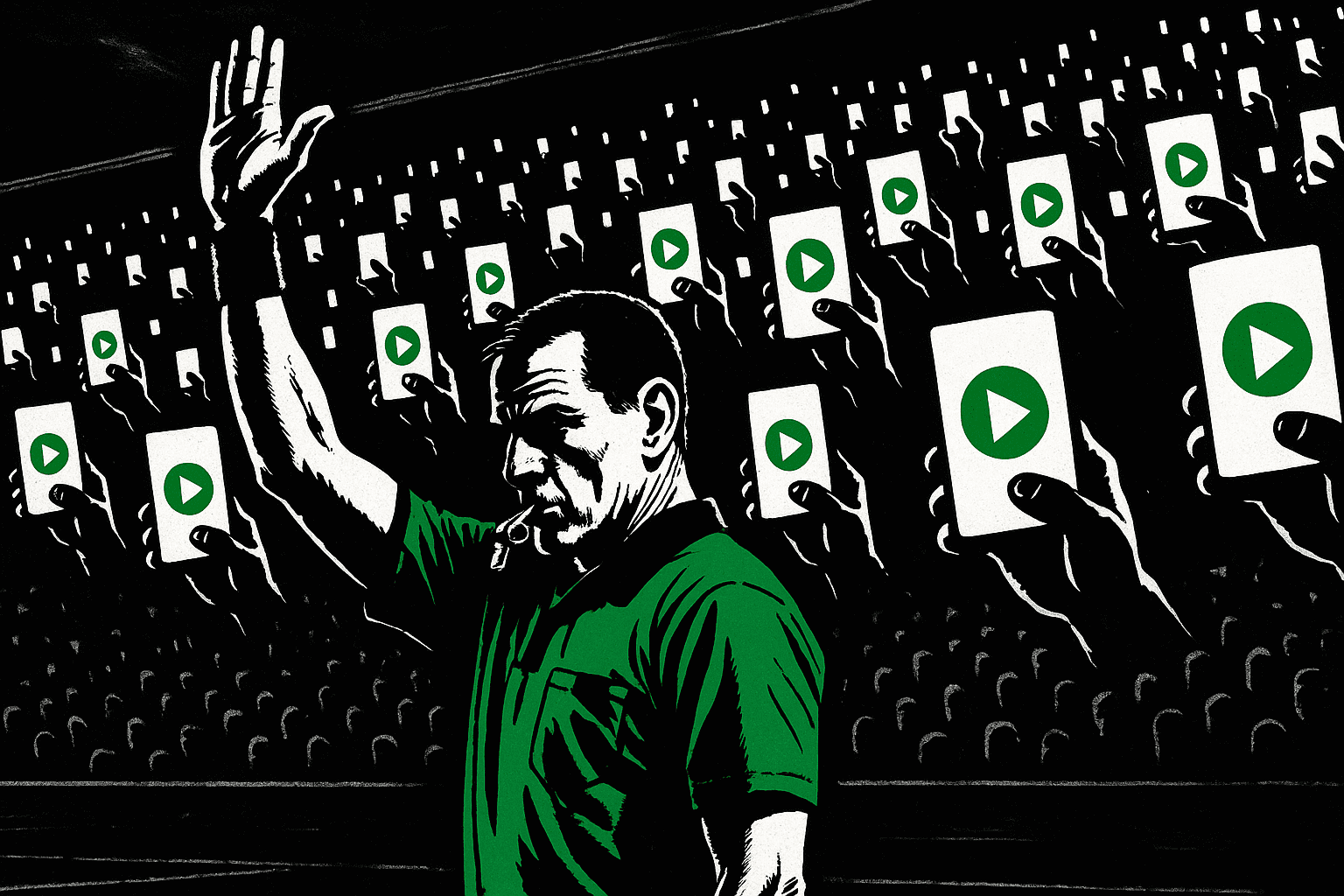
Set against that poor wretch sprinting with his tongue out: the VAR room. Unlimited time, physical rest, climate-controlled environment, multi-angle high-definition images. Two incompatible paradigms. One heuristic and intuitive, based on pattern recognition. The other analytical, deconstructing frame by frame. VAR was sold as the definitive objective referee. And it works brilliantly when it confines itself to the binary. Drawing the offside line, checking whether the ball left the field. There it is unbeatable, and controversy is nil because everyone perceives mathematical objectivity.
The disaster begins when that analytical magnifying glass turns to a standard. When VAR reviews a doubtful handball or a contested contact, it is not establishing a fact; it is re-evaluating an interpretation. And in decomposing a dynamic action into slow motion and multiple angles, it does not uncover any incontestable truth. It merely stacks the subjective interpretation of the man in the room on top of the subjective interpretation of the man on the pitch. Two opinions piled on top of each other that we call justice.
Worse still, slow motion lies. Several experimental studies have consistently demonstrated the so-called slow-motion bias. Deceleration distorts perceived time; the observer believes the player had ample opportunity to plan the movement, and it inflates the sense of intentionality. An accidental contact or an arm rising to protect balance becomes, in slow motion, a calculated assault. And the devastating part is that the bias persists even when you tell the referee the exact slow-down factor. Knowing it does not cure it. When the official goes to the monitor and watches the incident at reduced speed, the technology manipulates his perception and pushes him to punish as deliberate what at real speed was not.
The system has hierarchies on top of all this. It has been observed that younger or lower-ranked VAR referees tend to recommend more reviews, but their recommendations are overturned more frequently by established on-field referees. The rulebook does not rule; rank does. And there the principle of minimum interference, maximum benefit dies, replaced by an implicit pressure to cover one's back. Applying Daniel Kahneman's framework, what old-style reforms fought was bias, local favouritism. What VAR has multiplied is noise, undesirable variability in the face of identical cases. Two sets of officials looking at the same images of a minor handball hand down opposite verdicts. Pure noise.
Rule 12 on handballs is the monument to this failure. IFAB has spent years rewriting it to squeeze the subjectivity out of the word deliberate, and every version adds exceptions that ignore the basic physics of the human body. When jumping or running, arms function as counterweights. Asking a defender to move with elbows pinned to his torso is penalising him for being a mammal. Rule 11 is heading the same way with the distinction between deflection and deliberate play introduced by the IFAB circular for 2022/23. The assistant referee must now assess whether the defender had body control and the ability to pass or clear. He is no longer observing a fact; he is theorising about the psychological state and motor coordination of an opponent at the moment of impact. A neurological diagnosis in the blink of an eye.
The honest counter-argument exists and must be put on the table. Returning to total referee discretion would open the door to another monster: favouritism, the classic arbitrary call, the phantom goal nobody could review. VAR was born because clear and obvious errors were real and they hurt. Nobody with a memory wants to go back to the Hand of God with no replay. The question is not to bury the technology but to tame it. The analysis itself points the way. Dismantle the case law in Rules 11 and 12 to restore broad principles, restrict VAR to strictly factual matters, raise the threshold for intervention on standards to a grotesque and indisputable error, and ban slow motion for judging intent or intensity, reserving it solely to pinpoint the exact moment of contact.
Football tried to buy certainty with technology and what it paid for was more noise at higher resolution. Every season the rulebook gets fatter; every season decisions become less comprehensible. As long as IFAB keeps confusing the sharpness of the image with the clarity of the criterion, the next Embolo is already warming up on the touchline.