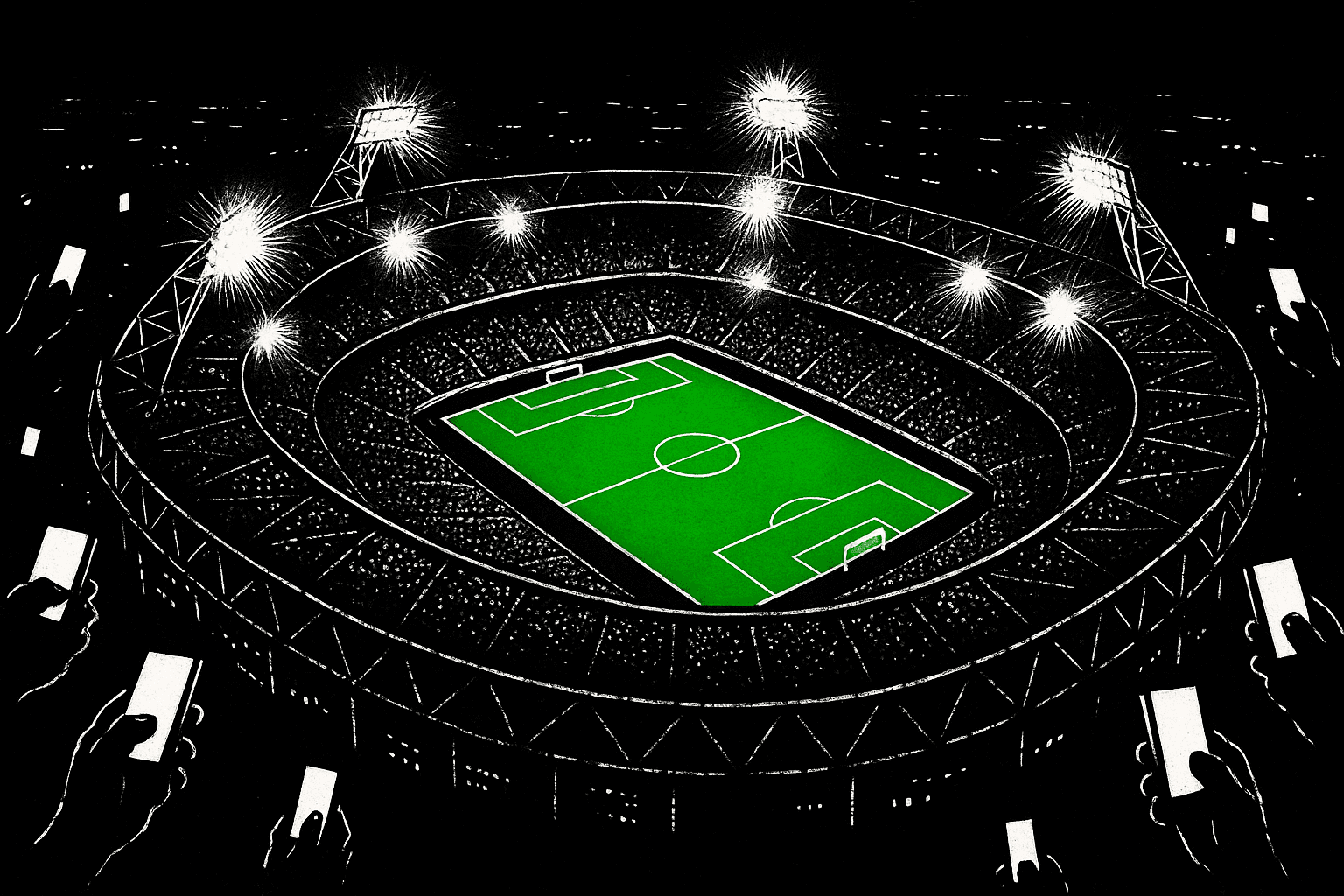

Zero. That is the number of new stadiums the 2026 World Cup will force into existence for its tournament. Three countries, sixteen venues, one hundred and four matches, and not a single crane set spinning specifically to please FIFA. In the recent history of the competition, where brick and mortar have been almost an entry requirement, the figure sounds like heresy. And yet there it is, marking the difference between a business and an elegant ruin.
The thesis is simple and worth stating right away. The 2026 World Cup has every chance of being the most profitable in history, not because it will generate more cash than any other, though it will, but because for the first time the mountain of revenue arrives without the parallel mountain of unrecoverable concrete. FIFA has set its revenue target for the 2023-2026 cycle at record figures and is advancing toward that mark at a good pace, according to its own financial statements. The interesting part is not the record. It is that the record coexists with extraordinarily low host capex. That decoupling of incoming money from sunk construction is the heart of the matter.
Here is the nuance that separates serious analysis from the candidacy brochure. Profitable, yes, but for whom? FIFA centralizes monetization, television, sponsorship, hospitality, ticketing. Cities decentralize operations, security, transport, fan zones, temporary venue adaptations. The commercial ledger and the cost ledger have never gotten along, and 2026 does not reconcile them. What it does is something cleverer. It cuts the most poisonous cost of all, the new construction that nobody later uses, and leaves standing the old asymmetric distribution of the surplus.
To see why this matters, just review the gallery of hosts who paid for the party. South Africa 2010 is the canonical counterexample. Nearly 29.8 billion rand in major public line items, five new stadiums, 13.5 billion on venues alone and another 13.6 billion on transport. And the tourists who traveled expressly for the Cup? They left behind 3.64 billion rand. The numbers do not add up, not even by force. Brazil 2014 repeated the play on a larger scale, with a consolidated matrix of 27.12 billion rand, of which almost 22.78 billion was public money, against some 6 billion in estimated tourist spending during the event. Russia 2018 raised the stakes to an official cost approaching one trillion rubles by the broadest estimates, with notable overruns on the initial budget. In all three cases, FIFA came away delighted and the local taxpayer came away with an empty wallet and a sixty-thousand-seat stadium in a city that cannot fill half of it.
Meanwhile, FIFA cycle revenues grew without pause from one edition to the next, according to its financial reports. The business curve rose. The host concrete curve rose with it. That correlation is the World Cup's historic curse, and it is exactly the one 2026 breaks.
The Canadian case is the most transparent and therefore the most useful. Public budget estimates point to a gross cost of hundreds of millions of Canadian dollars for Toronto and Vancouver, which after the expected federal transfers falls considerably for each city. Serious figures, no joke, but light years from the heavy construction budgets of the previous decade. In the United States, federal funds allocated for security are spread across the eleven host cities, and even so several journalistic estimates put the aggregate deficit of American cities in three-digit figures in the millions. The local problem does not vanish. It compresses. It becomes a matter of premium operations rather than a concrete hole.
And there the crack appears. Because American cities are already sharpening their claws for 2031. The argument they repeat is reasonable. If FIFA keeps ticketing, sponsorship and the core commercial lines, and leaves the venues the bill for security, mobility, urban festivities and regulatory compliance, the model will be more sustainable than Brazil's but just as unfair in the distribution. Less debt per brick, more dispute over the split of the loot. The next World Cup battle will not be fought on construction sites. It will be fought in the contracts.
The 2026 commercial projection explains the underlying greed. One hundred and four matches instead of sixty-four, millions of expected attendees, tickets and hospitality pointing toward record figures. More content to sell without multiplying the construction that supports it. For FIFA it is the accounting dream made calendar. For the host, it depends on the city and the scenario.
It is worth acknowledging the strongest objection before someone else throws it. That 2026 builds no stadiums does not mean it is free. Operating a tournament of this size in fifteen cities costs real money, and the contractual split leaves several venues exposed to losses. The conservative scenario, with security costs escalating and little capture of incremental spending, yields a moderate aggregate loss for venues and subnational governments. It is not absurd. It is a live risk. The difference is that in 2010 or 2014 the loss was guaranteed by the mere act of signing; in 2026 it is a possibility that depends on how operations are managed and how much tourism can be captured above a normal summer.
The base case, today the most defensible, points to an approximate break-even or a small positive result for the host coalition as a whole, with brutal dispersion among cities. Germany 2006 already taught that lesson. A rich country, mature networks, benefit tied more to image and tourism than to direct fiscal gain, and even so with a budgetary return far more modest than the optimistic narrative of the time. Reusing infrastructure improves the equation. It does not turn it into alchemy.
So the honest formulation of the thesis has three speeds. For FIFA, 2026 will clearly be the most profitable World Cup in history. For the three host countries as a whole, it will be reasonable, probably balanced, with a good risk profile. For each city on its own, it remains a lottery with the cards marked in favor of whoever runs the draw.
What comes next is already written in the negotiations now underway. The model of shared venues and recycled stadiums will be the new standard, not out of justice but out of fiscal survival. And the fight over the surplus, the one that used to be buried under tons of concrete, is finally going to surface. FIFA found a way to earn more by spending less on other people's construction. The cities now have to discover whether the premium operation they finance leaves them anything more than the bill and the photo.