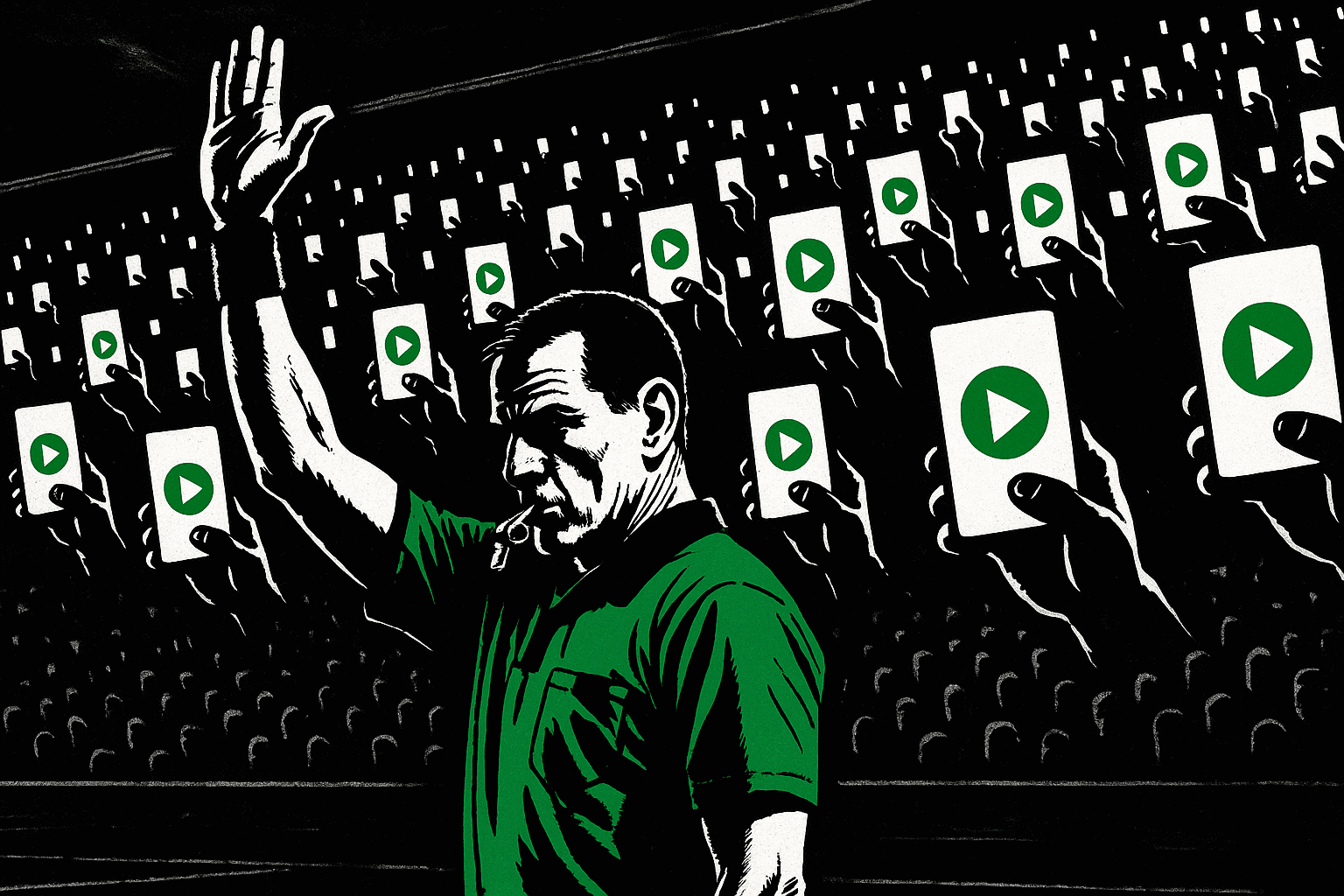

There is an experiment that should be burned into the mind of anyone who screams "robbery" from the couch. Italy, 2007. After a wave of stadium violence, several matches were played behind closed doors. No crowd. And then something curious happened. Pettersson-Lidbom and Priks went to look at what referees did in those empty stands, and they discovered that the favoritism toward the home team, the kind that shows up relentlessly match after match, simply evaporated. With no one shouting, officials stopped handing out fouls and cards to the home side. In some cases, the hosts even ended up receiving more sanctions.
That is the lab evidence. Pro-home referee bias exists, it is the most replicated finding in sports economics, and it is not caused by corruption or bribery. It is caused by stage fright. The social pressure of forty thousand people demanding a penalty.
And here comes the thesis, which almost no one is going to like. That bias is real and at the same time minuscule per match. It is measured in fractions of a card, in one or two minutes of stoppage time, in tenths of a point over an entire season. So small it can only be detected by averaging thousands of decisions. So when someone leaves the stadium swearing the referee robbed them of the match, they are almost always confusing two things that have nothing to do with each other. The systematic pattern, which is tiny, with the isolated error, which is rare but loud.
The problem is that the systematic pattern is documented with uncomfortable solidity. Garicano, Palacios-Huerta and Prendergast showed it in the Spanish league with a study that is already a classic. When the home team is losing by a goal, the referee adds time. When it is winning by one, he cuts it short. The figures point to substantially more stoppage time when the home team is losing and noticeably less when it is winning, several minutes up against a handful of seconds down on a base of three. And the effect grew with the size of the crowd. More people, more pressure, more leeway.
Dohmen replicated it in the Bundesliga and added a delicious detail. In stadiums with an athletics track, that strip physically separating the stands from the pitch, the bias was smaller. More distance, less pressure, less favoritism. Buraimo, Forrest and Simmons found the same in England and Germany with cards, where home sides systematically receive fewer than visitors. Sutter and Kocher counted penalties and home teams received quite a few more. And in case any doubt remained about the mechanism, Nevill had a group of qualified referees judge the same plays, some with crowd noise and others in silence. Those who heard the roar flagged considerably fewer infringements against the home side. Uncertainty under noise translates into indulgence.
Then the pandemic arrived and handed economists the greatest natural experiment in the history of football. The "ghost games" of 2020 and 2021, entire seasons without a soul in the stands. Bryson, Scoppa, Endrich and company went to look, and most leagues showed what was expected. Without a crowd, home advantage fell and the card bias against visitors narrowed or disappeared. Not equally everywhere. There is heterogeneity, there are leagues where the effect was lukewarm or debatable. But the direction was the one the theory predicted. Remove the pressure and the referee whistles straighter.
Up to this point, everything proves the outraged fan right. The bias exists. The favoritism exists. The thing is that it measures very little per match, and the cry of "robbery" requires it to measure a great deal. That is the trap.
Because there is one case in which a single decision really does change everything, and it is worth understanding properly so as not to use it as an alibi. It is the question of leverage, a concept that analytics imported from baseball along with Win Probability Added. The idea is simple and devastating. A goal is not always worth the same. It depends on the score and the minute. A penalty that breaks a 0-0 in the 90th minute turns an almost certain draw into an almost certain win. The probability swing is close to the maximum imaginable. The same penalty in the 10th minute barely moves the needle, because there is plenty of match left to respond.
So yes, the 90th-minute penalty in a 0-0 has an enormous impact on that specific match. The protester's intuition is mathematically correct. But there is a detail that always escapes them, and it is the one that turns the whole argument around. That enormous impact exists precisely because the match was still 0-0. The very high leverage of the last decision is the direct consequence of not having settled things earlier.
This is where football meets causality theory, and where the alibi collapses on its own. When we say "the referee robbed us" we commit a series of attribution errors that are perfectly catalogued. The first is confusing the proximate cause with the complete causal chain. In a succession of necessary conditions, each link weighs the same. That the team failed to score in ninety minutes is as much a cause of the result as the stoppage-time penalty. Hart and Honoré explained this decades ago. We point to as "the cause" whatever deviates from the expected, not whatever logically brought it about. It is a psychological choice disguised as objective judgment.
On top of that comes salience bias. We assign blame to the most recent, most dramatic and most visible event, which is almost always the last one. And the narrative fallacy, that need to build a story complete with a villain instead of accepting that the result is multicausal and partly random. The referee is a convenient villain. He has a face, he has a whistle, he has a name. The twelve missed chances have none of those things.
And there is outcome bias, which Baron and Hershey described with surgical precision. We judge the quality of what happened by the final score, not by the process. The same debatable refereeing decision is forgotten if the team wins 3-0 and becomes a national scandal if it loses 0-1. The play is identical. What changes is the result, and with it, our selective memory.
The statistical reality is brutal in its simplicity. A 0-0 is, in itself, proof that the attack performed below what was needed. The less margin a team generates, the greater the leverage of any isolated event, including a referee's mistake. Fragility before a single error is largely self-inflicted. The team that shoots a lot, that accumulates xG, that scores three goals, reduces to nearly zero the ability of any individual decision to change the match. The one that does not score maximizes it. It hands its fate to someone else.
It is worth being honest about the strongest objection, because there is one. Sometimes they do rob you. Sometimes the penalty is crystal clear, the replay confirms it, it falls at the minute of maximum leverage, and the wronged team had done more than enough to deserve the win. In that scenario, with those three conditions met at once, the complaint is legitimate. VAR, by the way, raised the precision of reviewable decisions, though its effect on home advantage is still debated. But those cases are rare. The vast majority of the time someone screams "robbery" the third condition is not met, the only one that truly matters. They had not done enough.
The referee does not decide the matches you leave open. He only collects the bill for your poor finishing, and he always does it at the worst possible minute.